AI Code Assistants Go Infrastructure-Grade: Skills, Sessions, and Standards
GitHub ships portable agent skills with provenance tracking, Anthropic rebuilds Claude Code for parallel sessions, GitHub Copilot adds cross-model review, and MCP hits 10,000+ servers.
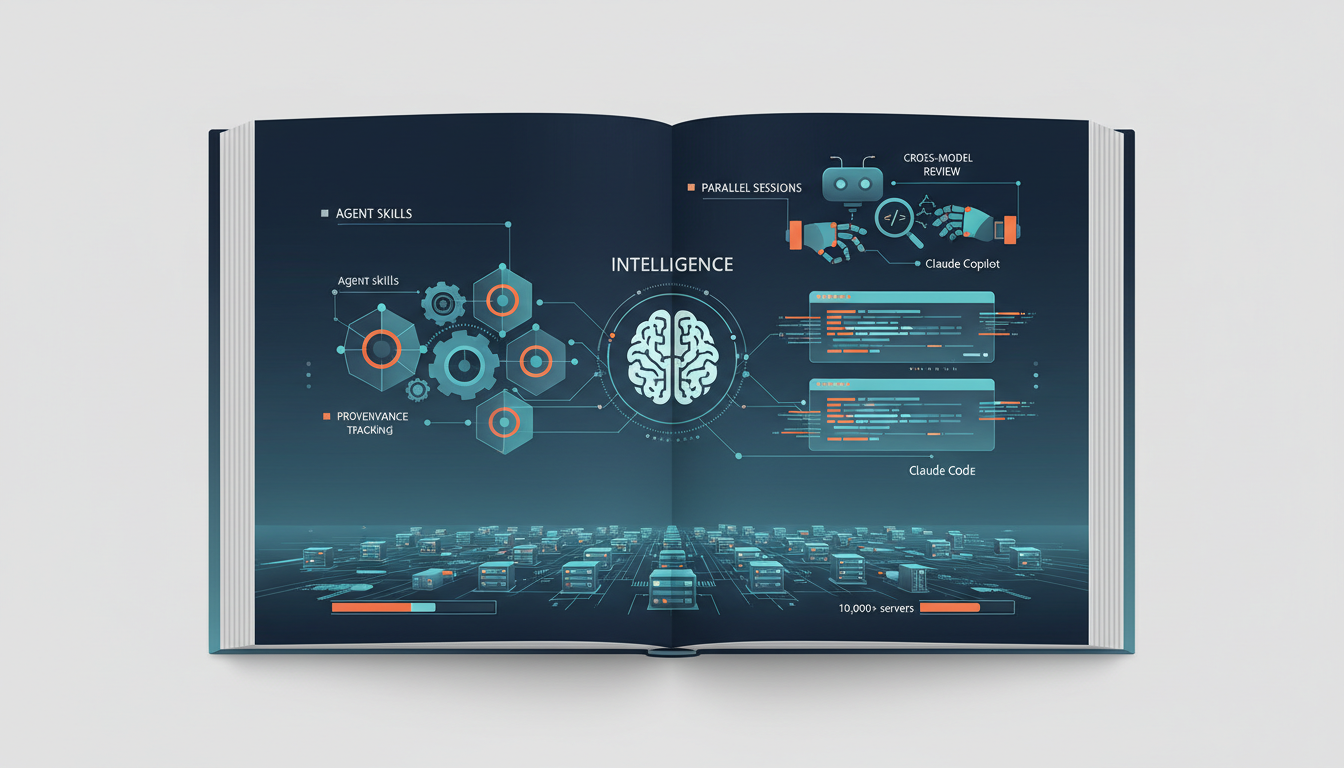
This week's releases signal a shift from experimental AI tools to production-grade infrastructure. GitHub launched native agent skill management, Anthropic rebuilt Claude Code around parallel sessions, and developers are composing multi-tool stacks instead of picking one winner. The common thread: code assistants are maturing from autocomplete into orchestration layers.
GitHub Ships Agent Skills CLI with Cross-Platform Spec
GitHub CLI v2.90.0 adds gh skill, a new command that turns one-off prompts into portable, version-pinned instructions. Agent skills work across GitHub Copilot, Claude Code, Cursor, Codex, and Gemini CLI through the open Agent Skills specification. The CLI brings package-manager guarantees to AI workflows: content-addressed updates detect real changes, tag protection prevents silent modifications, and provenance metadata tracks upstream sources.
For app dev teams, this means you can encode deployment checklists, API design patterns, or security review processes once and distribute them like npm packages. The community published over 1,000 skills within days of launch. Why it matters for builders: skills move from throwaway prompts to trackable, reviewable infrastructure—closer to Terraform modules than clipboard snippets.
Claude Code Desktop Gets Parallel-Session Redesign & Routines
Anthropic released a rebuilt Claude Code desktop app on April 14 with a new sidebar for managing multiple sessions, drag-and-drop panes, an integrated terminal, and a diff viewer built for large changesets. The redesign is organized around running 3–10 agents in parallel worktrees, each with isolated git state. Simultaneous with the desktop update, Anthropic launched Routines—scheduled cloud automations for PR reviews, CI triage, and doc syncs that run on Anthropic's infrastructure without requiring a laptop to stay awake.
App dev teams can now spin up frontend + backend + test agents concurrently, review diffs side-by-side, and automate recurring repo maintenance. The April 14 redesign is available to Pro, Max, Team, and Enterprise users. Why it matters for builders: single-threaded chat UIs are deprecated for serious development work—parallel sessions are the new baseline.
GitHub Copilot Adds Claude Opus 4.7 with 'Rubber Duck' Boost
GitHub Copilot CLI now supports Claude Opus 4.7 (launched April 16) with a new experimental 'Rubber Duck' feature that inserts GPT-5.4 as a second model to critique plans mid-task. Claude Sonnet 4.6 paired with Rubber Duck closed 74.7% of the performance gap between Sonnet and Opus on the SWE-Bench Pro benchmark. The feature runs automatically after planning, complex implementations, and test writing, or on demand via /experimental.
For dev teams, this means Copilot can draft a feature plan, have it reviewed by a second AI before execution, then self-correct stuck loops—all inside the terminal. Opus 4.7 delivers stronger multi-step task performance and more reliable agentic execution. Why it matters for builders: this is the first mainstream AI pair-programming tool with built-in peer review—a direct answer to the trust and quality concerns that have plagued AI code generation.
Composable AI Coding Stack Emerges: Cursor + Claude + Codex
Developers are composing Cursor (orchestration), Claude Code (execution), and OpenAI Codex (async tasks) into a three-layer stack instead of picking one tool. Cursor 3 launched April 2 with parallel agents and a dedicated Agents Window, while Claude Code and Codex added cross-provider review patterns where one model writes and another critiques. For app dev teams, this means you can use Cursor's 8 parallel agents for feature sprints, delegate long-running refactors to Claude's cloud agents, then run Codex as a background reviewer—all in one workflow.
The pattern mirrors infrastructure tooling (Terraform + Docker + Kubernetes) over monoliths. SemiAnalysis estimates Claude Code accounts for 4% of public GitHub commits as of March 2026, with projections to hit 20% by year-end. Why it matters for builders: the stack is stabilizing around specialization, not winner-take-all. Developer surveys show 46% now "most love" Claude Code, but many pair it with Cursor for orchestration.
MCP (Model Context Protocol) Becomes Cross-Vendor Agent Glue
MCP servers—now 10,000+ published—are adopted by GitHub Copilot, Claude, Cursor, VS Code, and ChatGPT as the standard for connecting AI agents to databases, APIs, and internal tools. Developers write one MCP server (filesystem, Postgres, GitHub, Slack) and every agent can use it without custom glue code. For app dev teams, this means your CI/CD pipelines, issue trackers, and monitoring tools become queryable via natural language across any code assistant.
The Linux Foundation's Agentic AI Foundation (launched December 2025 with Anthropic, OpenAI, Google, Microsoft) now governs the spec, cementing it as infrastructure-grade. April 2026 updates include MCP Apps (interactive UIs in chat) and expanded GitHub Copilot CLI support. 97M monthly SDK downloads were recorded in March 2026, and Forrester predicts 30% of enterprise SaaS vendors will ship MCP servers by end-2026. Why it matters for builders: production-grade features like audit trails, SSO integration, and gateway patterns are now roadmap priorities for 2026.
What to watch
- Cross-model review as CI step: GitHub's Rubber Duck pattern (one model writes, another critiques) could migrate from developer workflow into automated PR checks. Watch for GitHub Actions integrations that enforce second-opinion validation before merge.
- Agent skill supply chain: With 1,000+ skills published in week one, provenance and security scanning become critical. GitHub's tag protection and content-addressed updates are first steps; expect tooling for skill auditing and dependency graphs.
- MCP enterprise readiness: The 2026 roadmap flags audit trails, SSO-integrated auth, and gateway behavior as top priorities. Organizations evaluating MCP should track the Enterprise Working Group for standardized governance patterns.
- Parallel-session UX convergence: Both Claude Code (April 14) and Cursor 3 (April 2) shipped parallel-agent interfaces within two weeks. Expect VS Code, JetBrains, and other IDEs to follow with multi-session sidebar patterns by Q3 2026.
Sources
- Manage agent skills with GitHub CLI - GitHub Changelog
- Release GitHub CLI 2.90.0 · cli/cli
- About agent skills - GitHub Docs
- GitHub - VoltAgent/awesome-agent-skills
- Anthropic Rebuilds Claude Code Desktop App Around Parallel Sessions - MacRumors
- Redesigning Claude Code on desktop for parallel agents | Claude
- GitHub Copilot CLI adds new feature to massively boost AI performance by almost 75 percent - Neowin
- GitHub Copilot CLI combines model families for a second opinion - The GitHub Blog
- Claude Opus 4.7 is generally available - GitHub Changelog
- Cursor, Claude Code, and Codex are merging into one AI coding stack nobody planned - The New Stack
- Claude Code vs Cursor: What to Choose in 2026
- Model Context Protocol - Wikipedia
- Linux Foundation Announces the Formation of the Agentic AI Foundation (AAIF)
- The Rise of Model Context Protocol: Bridging AI and External Systems
- What is MCP (Model Context Protocol)? The 2026 Guide for SaaS PMs | Truto Blog
- The 2026 MCP Roadmap | Model Context Protocol Blog
- Adding MCP servers for GitHub Copilot CLI - GitHub Docs
Related reading
Production RAG Frameworks Level Up: Durable Workflows, Better Parsing, and Cross-Platform Agents
Five major framework releases this month solve critical production gaps for RAG: durable execution, parsing benchmarks, and multi-agent orchestration across .NET, Python, and TypeScript.
Adding Google Gemini to a React App: A Practical Guide with Code
How to plug Google Gemini into a real React app — streaming, tool use, cost controls, and the security pitfalls we see most often.
React Native vs Flutter in 2026: Which Should Your Startup Choose?
After shipping mobile apps on both, here is how we pick between React Native and Flutter for real clients in 2026 — decision framework included.